
Species Name
Zebra Shark
Scientific Name
Stegostoma tigrinum
Family Name
Stegostomidae
IUCN Status
Endangered
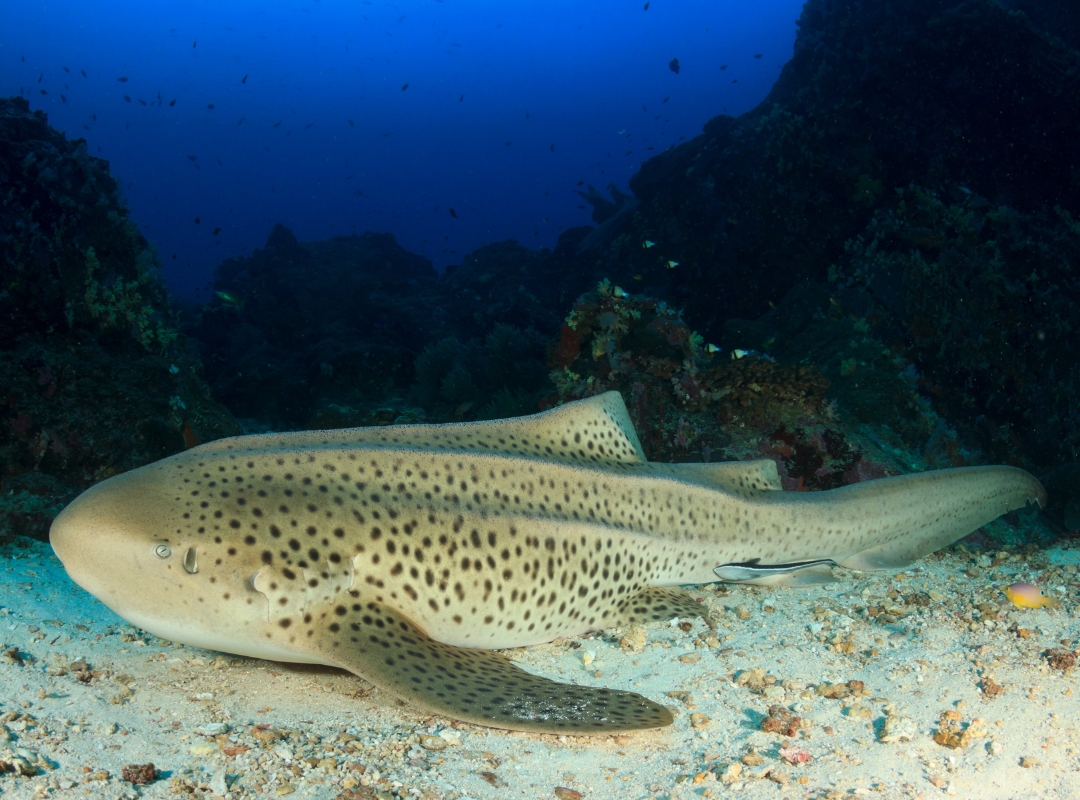
Two color morphs, with a three-stage ontogenetic color and pattern change: the Zebra morph with juveniles with dark brown background and cream colored bands (zebra-like), transitionals light brown with dark bands, broken up by dots and adults beige to yellow with spotted pattern (can be leopard-like); the sandy color morph: transitionals light beige background with swirly pattern of narrow, darker brown bands with tiny spots breaking up the pattern and with adults uniformly sandy beige with tiny dark brown freckles.
Biology
Length: Adults reach a maximum size of 354 cm TL. Size at birth 20-26 cm TL.
Gestation Period: 5-6 months for Stegostoma fasciatum.
Litter Size: 40-80 eggs per year, one litter size: about 10-20
Life Expectancy: Generation length estimates based on 6 years first age at maturity and 28 years maximum longevity for female sharks is 17 years.
Diet: Probably nocturnal, feeds mainly on molluscs, but also small bony fishes. Also known to eat crustaceans (crabs and shrimps) and sea snakes.
Habitat and distribution
Habitat: A tropical inshore shark found on sand, rubble, or coral bottoms of the continental and insular shelves. Recorded to have entered freshwater. Rather sluggish at least during the day. Slow-swimming and able to squirm into narrow cracks, crevices and channel in reefs while searching for food.
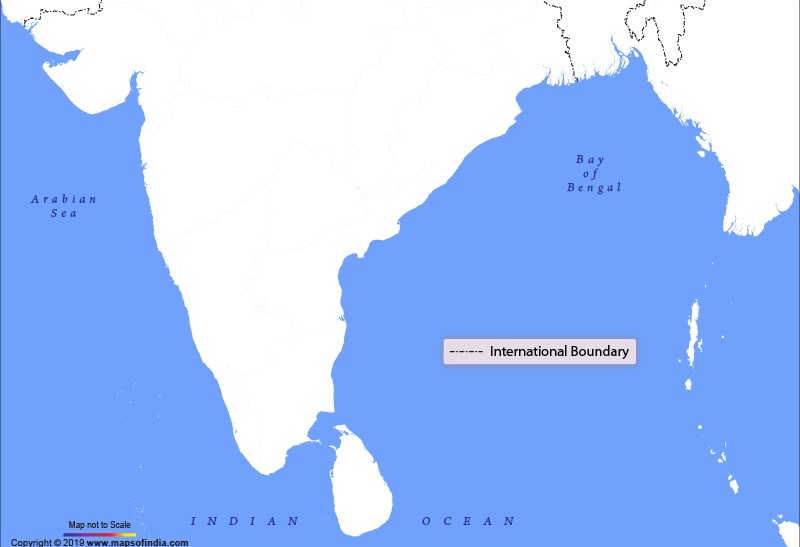
Distribution: The Zebra Shark is found in inshore waters of the continental and insular shelves of the Western Pacific and Indian Oceans.
Depth: 0-62 m
Known landing centres:
Commercial value
Zebra Sharks are landed whole and used for their fins, skin (dried), meat and cartilage. They are kept in aquaria around the world. They breed well in aquaria and eggs and adults are also taken from the wild for aquaria stock. They are valuable within the recreational SCUBA diving industry, particularly in eastern Australia waters and near Phuket in Thailand.
Threats
Compagno, L.J.V. (2001)
Sharks of the world. An annotated and illustrated catalogue of shark species known to date. Vol. 2. Bullhead, mackeral and carpet sharks (Heterodontiformes, Lamniformes and Orectolobiformes). FAO species catalogue for fisheries purposes. No. 1. Vol. 2. FAO, Rome.
Anderson, R.C. (2002)
Elasmobranchs as a recreational resource. In: S.L. Fowler, T.M. Reed & F.A. Dipper (ed.), Elasmobranch Biodiversity, Conservation and Management: Proceedings of the International Seminar and Workshop. Sabah, Malaysia. July 1997. pp. 46–51. IUCN SSC Shark Specialist Group. IUCN, Gland, Switzerland and Cambridge, UK.
Henderson, A.C., McIlwain, J.L., Al-Oufi, H.S. and Al-Sheili, S. (2007)
The Sultanate of Oman shark fishery: Species composition, seasonality and diversity. Fisheries Research 86: 159-168.
White, W.T., Last, P.R., Stevens, J.D., Yearsley, G.K., Fahmi and Dharmadi. (2006)
Economically Important Sharks and Rays of Indonesia. Australian Centre for International Agricultural Research, Canberra, Australia.
Dahl, R.B., E.E. Sigsgaard, G. Mwangi, P.F. Thomsen, R.D. Jørgensen, F. de Oliveira Torquato, L. Olsen and P.R. Møller (2019)
The sandy zebra shark: A new color morph of the zebra shark Stegostoma tigrinum, with a redescription of the species and a revision of its nomenclature. Copeia, 107(3):524-541.