Species Name
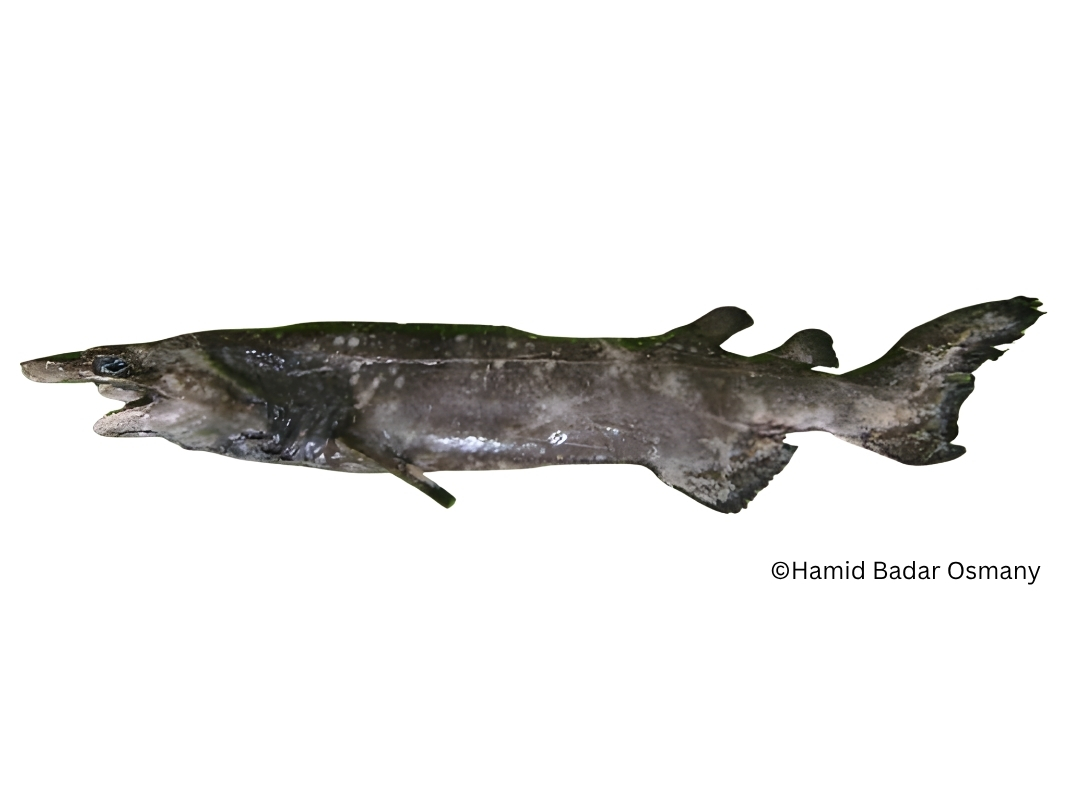
Bramble Shark
Scientific Name
Echinorhinus brucus (bonnaterre, 1788)
Family Name
Echinorhinidae
IUCN Status
Endangered
The bramble shark has thorn-like denticles on body which are very large (single denticles up to about 15mm in basal diameter in adults), sparse irregularly distributed and thorn-like with smooth basal margins. Two small spineless dorsal fins, close together, towards posterior part of body and originating behind pelvic fin origin.
Biology
Length: It reaches a maximum size of 394 cm total length (TL); males mature ~150 cm TL and females mature at 200–220 cm TL. Size-at-birth is estimated at 40–50 cm TL
Gestation period: Unknown
Litter size: 15-26
Life expectancy: Female age-at-maturity is estimated at 7 years and maximum age is estimated at 25 years, resulting in a generation length of 16 years.
Diet: Feeds on smaller sharks, bony fishes, and crabs.
Habitat and distribution
Habitat: Found on continental and insular shelves and upper slopes. Sometimes found in shallow water.
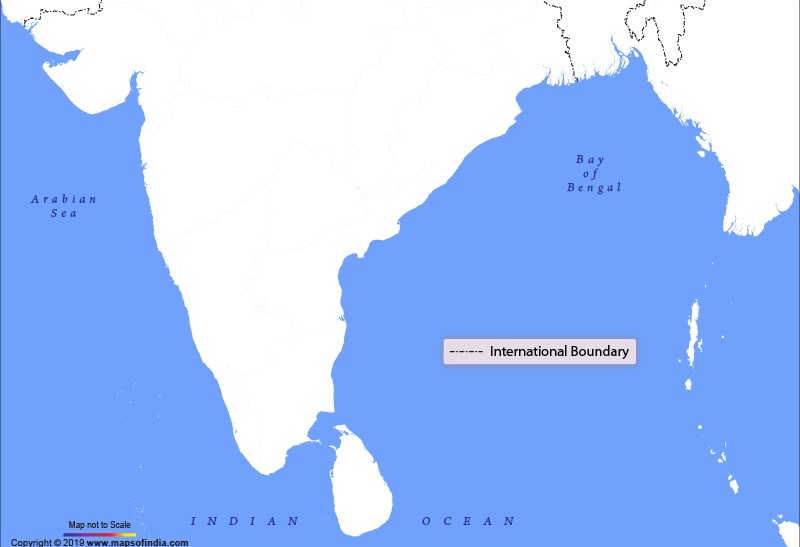
Distribution: The Bramble Shark has a has a widespread, yet patchy, global distribution in the Mediterranean Sea, and the Atlantic, Indian and western Pacific Oceans.
Depth: 10-900 m
Known landing centres: Thoothukudi, Threshpuram, Tharuvaikulam, Vembar, Vellapatti, Cochin Fisheries Harbour.
Commercial value
Bramble Shark liver oil, rich in squalene, is considered one of the most valuable of shark liver oil and is an important marine resource for local communities. The oil may be processed locally or shipped overseas (e.g. Dubai) for processing before sold on the international market. High grade oil is exported to Japan and the European Union. Flesh is sold to local markets.
Threats
The Bramble Shark has been taken as both targeted and incidental catch across its range in demersal trawl, longline, and setnet fisheries. The species is infrequently reported across most of its range. The Bramble Shark is a major component of the bycatch of intensive fisheries operating off southwest India. Fisheries employing a number of gear types (trawl, longline, gill net, hook and line) have expanded further offshore into deeper waters as inshore stocks become heavily exploited. In 1999, a deep-water shrimp trawl fishery developed and expanded rapidly; trawler numbers peaked the following year (2000–2001) before declining significantly, although there are still some 300–400 boats operating in the fishery. A targeted gulper shark liver oil fishery (operating at depths of >300–1,000 m) commenced in 2002, and between 2002–2008, there was a major increase in landings of deep-water sharks. Targeting gulper shark fishing has also occurred off the Andaman Islands and Sri Lanka since the 1980s, and the species may also been previously reported from the gulper shark fishery operating off the Maldives. This fishery collapsed and closed after <20 years of operation. Deep-water sharks have been targeted in demersal longline and gillnet fisheries operating in areas managed under the Southern Indian Ocean Fisheries Agreement (SIOFA); the latter of these fisheries ceased in 2015. An ecological risk assessment framework for deep-water sharks found the Bramble Shark to have high vulnerability to demersal trawl in South Pacific Ocean fisheries.
References
Akhilesh, K., Anulekshmi, C., Bineesh, K., Ganga, U. and Pillai, N. (2020)
Demographics of a heavily exploited deep water shark Echinorhinus cf. brucus (Bonnaterre, 1788) from the south-eastern Arabian Sea. Indian Journal of Fisheries 67: 8-15.
Ebert, D.A., Fowler, S. and Compagno, L. (2013)
Sharks of the World. Wild Nature Press, Plymouth.
Georgeson, L., Rigby, C.R., Emery, T.J., Fuller, M., Hartog, J., Williams, A.J., Hobday, A.J., Duffy, C.A.J., Simpfendorfer, C.A., Okuda, T., Stobutzki, I.C. and Nicol, S.J. (2019)
Ecological Risk Assessment for SPRFMO Deepwater Chondrichthyans. 7th Meeting of the Scientific Committee . South Pacific Regional Fisheries Management Organisation, La Havana, Cuba, 7 to 12 October 2019.
Iglésias, S.P., Mollen, F.H. and Naylor, G.J.P. (2018)
L’histoire de la disparition précoce du Squale bouclé (Echinorhinus brucus) révélée par une approche intégrative en écologie historique. VIIe Rencontres de l’Ichtyologie en France. Paris, 27-30 mars 2018.
Fernandez, T.J., Vipin, P.M., Pradeep, K., Ravi, R., Remesan, M.P. and Boopendranath, M.R. (2015)
Myctophid discards from deep sea shrimp trawlers operating off south-west coast of Kerala. Indian Journal of Geo-Marine Science 44(7): 1053-1058.
Jabado, R.W., Kyne, P.M., Pollom, R.A., Ebert, D.A., Simpfendorfer, C.A., Ralph, G.M. and Dulvy, N.K. (eds.). (2017)
The conservation status of sharks, rays, and chimaeras in the Arabian Sea and adjacent waters. Environment Agency – Abu Dhabi, UAE and IUCN Species Survival Commission Shark Specialist Group, Vancouver, Canada.