
Species Name
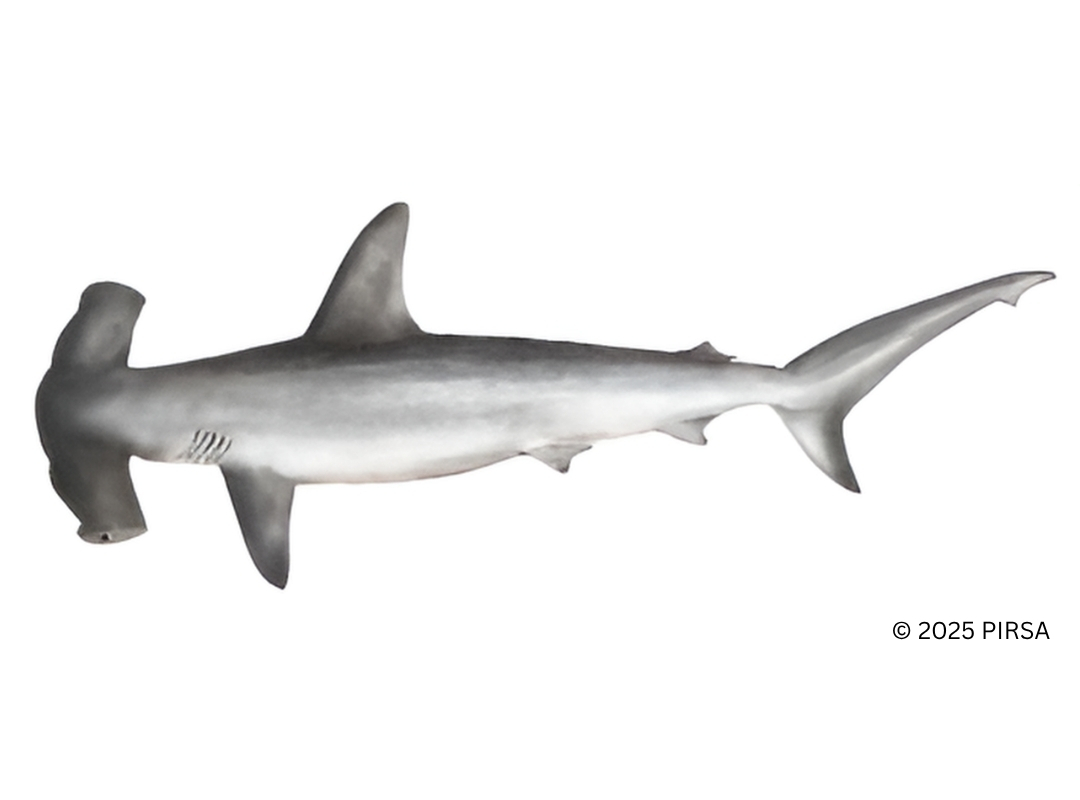
Smooth Hammerhead
Scientific Name
Sphyrna zygaena
Family Name
Sphyrnidae
IUCN Status
Vulnerable
A large hammerhead without a notch at the center of the curved head. Colour olive-grey or dark grey above, white below, and the undersides of the pectoral fin tips dusky.
Biology
Length: It attains a maximum size of 370–400 cm total length (TL). Males mature at 250–260 cm TL and females at about 246–265 cm TL. Size-at-birth of 49–63 cm TL
Gestation period: 10-11 months
Litter size: 20-50
Life expectancy: The maximum ages observed are 24 years for females and 25 years for males. However, these are unlikely to be the true maximum ages as individuals from the study were a maximum size of 286 cm TL, considerably less than the known maximum size. Generation length is estimated at 24.1 years based on that of Scalloped Hammerhead which reaches a similar size and has a maximum age of 35 years.
Diet: Prefers to feed on small sharks, skates and stingrays. Also preys on bony fishes, shrimps, crabs, barnacles and cephalopods.
Habitat and distribution
Habitat: Occurs inshore and well offshore, over continental and insular shelves. Coastal, pelagic, and semi-oceanic, but often bottom associated at 1-139 m. Migrates northward in summer; young often in large aggregations of hundreds of individuals.
Distribution: The smooth hammerhead occurs worldwide in temperate seas and in some regions, it is present in tropical seas.
Depth: 1-200 m
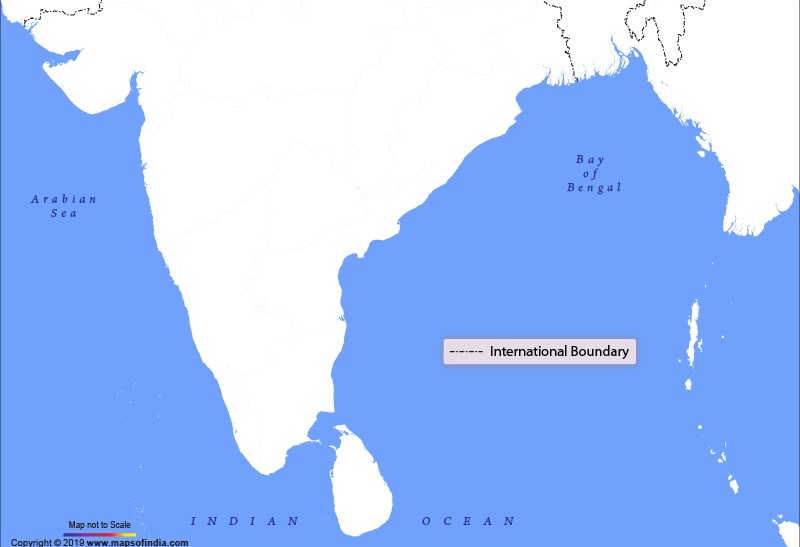
Known landing centres: Digha Mohana, Parangipettai, Therkuvadi, Keelakarai, Royapuram fishing harbour, Cuddalore fishing harbour, Nagapattinam fishing harbour, Thoothukudi, Threshpuram, Tharuvaikulam, Vembar, Vellapatti, Malim, Betul, Cochin fisheries harbour, Junglighat, Burma nallah
Commercial value
The main product from the species that is traded is the fins (CITES 2013). Hammerhead fins are among the main shark species in the fin trade and one of the preferred species for shark fin soup. Smooth Hammerhead accounted for 1.7% of the fin imported and was the fourth most abundant traded fin species in Hong Kong in 2014. The meat, liver oil, skin, cartilage, and jaws may also be used.
Threats
The Smooth Hammerhead is caught globally as target and bycatch in commercial and small-scale pelagic longline, purse seine, and gillnet fisheries. It is also captured in coastal longlines, gillnets, trammel nets, and sometimes trawls, particularly in areas with narrow continental shelves, and in some areas, such as Peru, this includes capture of pregnant females and juveniles. The species is often retained for the fins, unless regulations prohibit retention. Under-reporting of catches in pelagic and domestic fisheries is likely. High at-vessel mortality of 71% was estimated on Portuguese longlines in the Atlantic. The post-release mortality is higher for injured released sharks; it has been reported as 100% for the closely-related Scalloped Hammerhead in purse seines. The Smooth Hammerhead is taken in beach protection programs that target large sharks with high mortality in the beach mesh nets in New South Wales of ~95% prior to 2010; nearly all of the Smooth Hammerhead catch is juveniles.
References
Rosa, D., Coelho, R., Fernandez-Carvalho, J., Santos, M.N. (2017)
Age and growth of the smooth hammerhead, Sphyrna zygaena, in the Atlantic Ocean: comparison with other hammerhead species. Marine Biology Research 13(3): 300-313.
Reid, D.D. and Krough, M. 1992. Assessment of catches from protective shark meshing off New South Wales beaches between 1950 and (1990)
Australian Journal of Marine and Freshwater Research 43: 283–296.
Reid, D.D., Robbins, W.D. and Peddemors, V.M. (2011)
Decadal trends in shark catches and effort from the New South Wales, Australia, Shark Meshing Program 1950-2010. Marine and Freshwater Research 62: 676-693.
Rice, J., Tremblay-Boyer, L., Scott, R., Hare, S. and TIdd, A. (2015)
Analysis of stock status and related indicators for key shark species of the Western Central Pacific Fisheries Commission. In: Western Central Pacific Fisheries Commission (ed.), Scientific Committee Eleventh Regular Session, 5-13 August 2015, Pohnpei, Federated States of Micronesia.