
Species Name
Bowmouth Guitarfish
Scientific Name
Rhina ancylostoma (bloch & schneider, 1801)
Family Name
Rhinidae
IUCN Status
Critically Endangered
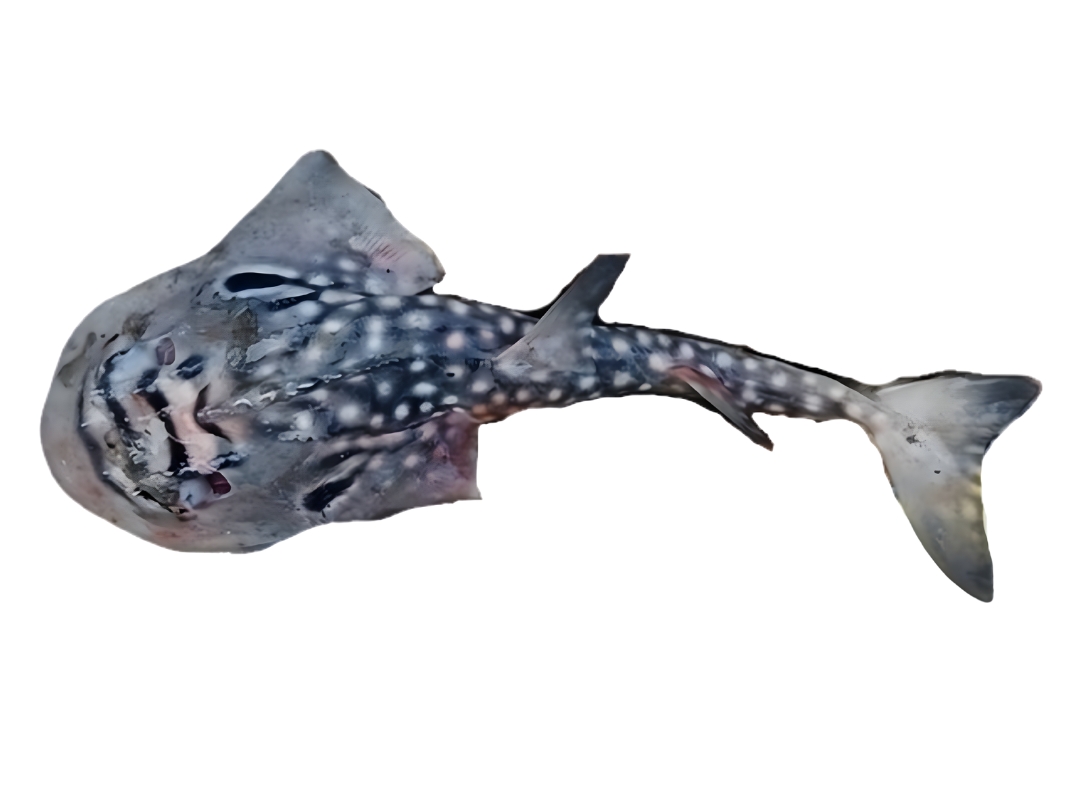
An unmistakable guitarfish with a broad, rounded snout, large, high pectoral fins, and heavy ridges of spiky thorns over the eyes and on the back and shoulders; jaws with heavily ridged, crushing teeth in undulating rows. Grey or brownish above, white below; numerous white spots dorsally on fins, body and tail; black spots on head and shoulders but no eyespots or ocelli
Biology
Length: Maximum size is 270 cm total length (TL); males mature at 150–175 cm TL; females at ~180 cm TL. Size at birth of 46–48 cm TL.
Gestation period: Unknown
Litter size: 2-11
Life expectancy: Generation length is estimated as 15 years.
Diet: Feeds mainly on bottom crustaceans and molluscs.
Habitat and distribution
Habitat: Inhabits coastal areas and on coral reefs, close inshore. Found on sand and mud bottoms. Sometimes found in the water column.
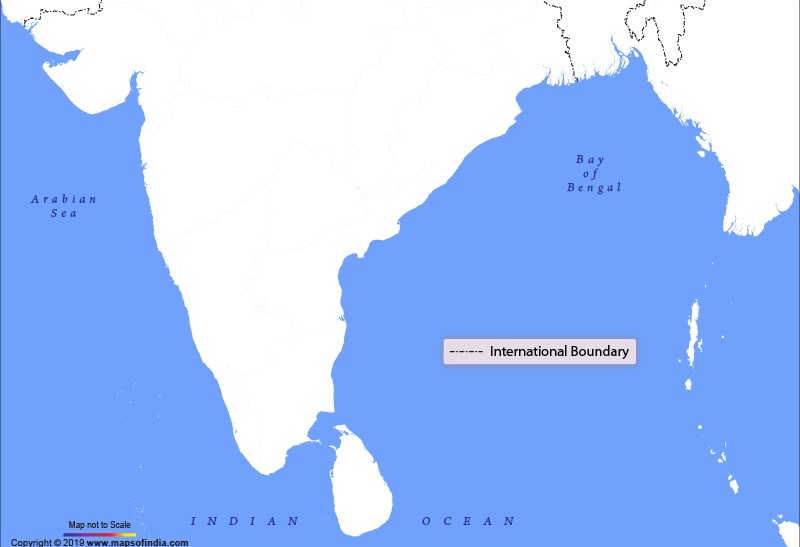
Distribution: The Bowmouth Guitarfish is widespread in the Indo-West Pacific from South Africa through the Western Indian Ocean, the Arabian Sea, Southeast Asia, and extending north to Japan, south to Australia (where it is wide-ranging across the north of the continent), and east to New Caledonia.
Depth: 0-70 m
Known landing centres: Royapuram fishing harbour, Cuddalore fishing harbour, Nagapattinam fishing harbour, Thoothukudi, Threshpuram, Tharuvaikulam, Vembar, Vellapatti, Mangaluru, Malpe, Cochin fisheries harbour, Malvan, Veraval, Thoothukudi
Commercial value
Wedgefishes are heavily utilized across their range for the meat and fins. The exception for this species is Australia where wedgefishes are generally not utilized or traded. Large whole wedgefishes (>200 cm total length; TL) have been traded for a high value of up to US$680 each, however, smaller specimens can sell for low value. The ‘white’ fins of shark-like rays (including wedgefishes and giant guitarfishes) are considered the best quality fins for human consumption and are among the highest valued in the international shark fin trade. Fin prices in the literature include US$396/kg for wedgefish fins and an average price of US$276/kg and US$185/kg for Qun chi (fins from shark-like rays) in Guangzhou (mainland China) and Hong Kong, respectively. The skin may be dried and traded internationally as a luxury leather product. The eggs of shark-like rays are sometimes dried and consumed locally while the heads may also be dried and used as either fish meal or fertilizer.
Threats
Globally, wedgefishes are subject to intense fishing pressure on their coastal and shelf habitats that is unregulated across the majority of their distributions. Wedgefishes are captured in industrial, artisanal, and subsistence fisheries with multiple fishing gears, including gillnet, trawl, hook and line, trap, and seine net and are generally retained for their meat and fins.
References
Compagno, L.J.V. and P.R. Last (1999)
Rhinidae (=Rhynchobatidae). Wedgefishes. p. 1418-1422. In K.E. Carpenter and V. Niem (eds.) FAO identification guide for fishery purposes. The Living Marine Resources of the Western Central Pacific. FAO, Rome.
Michael, S.W. (1993)
Reef sharks and rays of the world. A guide to their identification, behavior, and ecology. Sea Challengers, Monterey, California. 107 p.
Suzuki, T. (2002)
Development of shark fisheries and shark fin export in Indonesia: case study of Karangsong Village, Indramayu, West Java. In: Fowler, S.L., Reed, T.M. and Dipper, F.A. (eds), Elasmobranch Biodiversity, Conservation and Management: Proceedings of the International Seminar and Workshop, Sabah, Malaysia, July 1997, pp. 149–157. IUCN SSC Shark Specialist Group, Gland, Switzerland and Cambridge.
Last, P., White, W., de Carvalho, M., Séret, B., Stehmann, M. and Naylor, G. (2016)
Rays of the World. CSIRO Publishing, Clayton.
Tous, P., Ducrocq, M., Bucal, D. and Feron, E. (1998)
Shark populations are possibly under serious threat in the Bijagos archipelago (Biosphere Reserve), Guinea Bissau, West Africa. Shark News. Newsletter of the IUCN Shark Specialist Group 10: 4.