
Species Name
Hooktooth Shark
Scientific Name
Chaenogaleus macrostoma
Family Name
Hemigaleidae
IUCN Status
Vulnerable
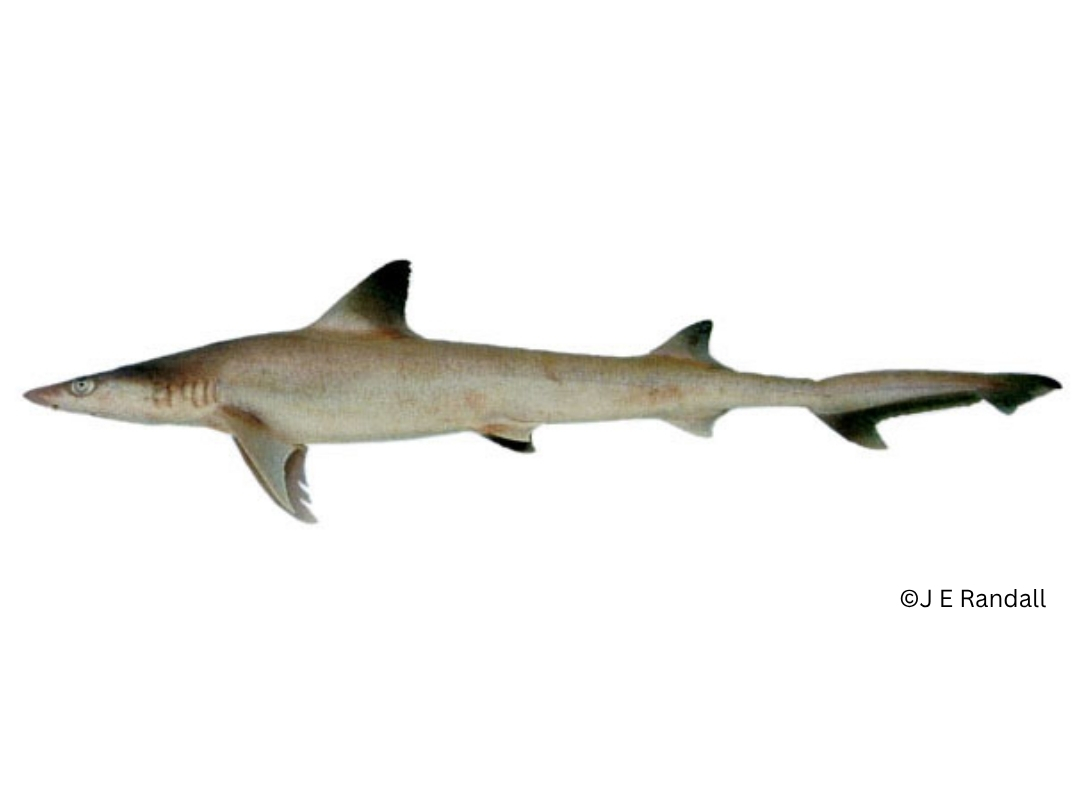
Bronzy-grey above, white below when fresh, fading to greyish or greyish brown in preservation, dorsal fins often with dusky or black tips.
Biology
Length: It reaches a maximum size of 125 cm total length, males mature at ~72 cm TL and females mature at 68–97 cm TL. Size-at-birth of ~20 cm TL
Gestation Period: Unknown
Litter Size: 4
Life Expectancy: Age-at-maturity of 5–6 years and maximum age of 11 years, resulting in an estimated generation length of 8 years.
Diet: Probably feeds on small fishes, cephalopods, and crustaceans.
Habitat and distribution
Habitat: A common inshore and offshore shark found on the continental and insular shelves.
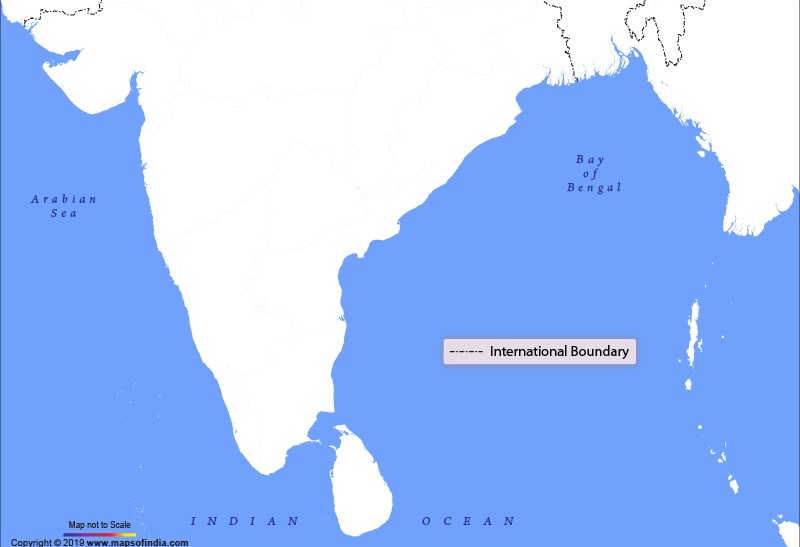
Distribution: The Hooktooth Shark has a patchy distribution across the Indo-West Pacific and Eastern and Western Indian Oceans from the Arabian Sea to the South China Sea.
Depth: 0-160 m
Known landing centres: Royapuram Fishing Harbour, Cuddalore Fishing Harbour, Nagapattinam Fishing Harbour, Thoothukudi, Threshpuram, Tharuvaikulam, Vembar and Vellapatti, Cochin Fisheries Harbour, Thiruvananthapuram, Junglighat, Burma Nallah
Commercial value
The meat of this species is often sold fresh for human consumption at local markets across the region. Fins are not considered valuable due to their small size but are still traded internationally. In India, the offal is sometimes processed into fishmeal.
Threats
This species is subject to intense fishing pressure across its range. It is taken as bycatch in industrial and artisanal fisheries with multiple fishing gears including trawl, gillnet, and handline and retained for the meat and fins and for fish meal. Indirect and sublethal sources of mortality include coastal habitat destruction and degradation with dramatic levels of habitat loss evident in the region.
References
Henderson, A.C., Al-Oufi, H. and McIlwain, J.L. (2004)
Survey, status and utilization of the elasmobranch fisheries resources of the Sultanate of Oman. Department of Marine Science and Fisheries, Sultan Qaboos University, Muscat, Oman.
Hoq, M.E., Haroon, M.K.Y., Karim, E. (2014)
Shark fisheries status and management approach in the Bay of Bengal, Bangladesh. In: Wahab, M.A., Shah, M.S., Hossain, M.A.R., Barman, B.K. and Hoq, M.E. (eds), Advances in Fisheries Research in Bangladesh: I. Proc. of 5th Fisheries Conference & Research Fair 2012. 18-19 January 2012 1 1: 233-246. Dhaka, Bangladesh.
Manilo, L.G. and Bogorodsky, S.V. (2003)
Taxonomic composition, diversity and distribution of coastal fishes of the Arabian Sea. Journal of Ichthyology 43: S75-S149.
White, W.T., Last, P.R., Stevens, J.D., Yearsley, G.K., Fahmi and Dharmadi (2006)
Economically Important Sharks and Rays of Indonesia. Australian Centre for International Agricultural Research, Canberra, Australia.
Weigmann, S. (2016)
Annotated checklist of the living sharks, batoids and chimaeras (Chondrichthyes) of the world, with a focus on biogeographical diversity. Journal of Fish Biology 88(3): 837-1037.
Compagno, L.J.V. (1998)
Hemigaleidae. Weasel sharks. p. 1305-1311. In K.E. Carpenter and V.H. Niem (eds.) FAO identification guide for fishery purposes. The Living Marine Resources of the Western Central Pacific. FAO, Rome.