
Species Name
Oceanic Manta Ray
Scientific Name
Mobula birostris
Family Name
Mobulidae
IUCN Status
Endangered
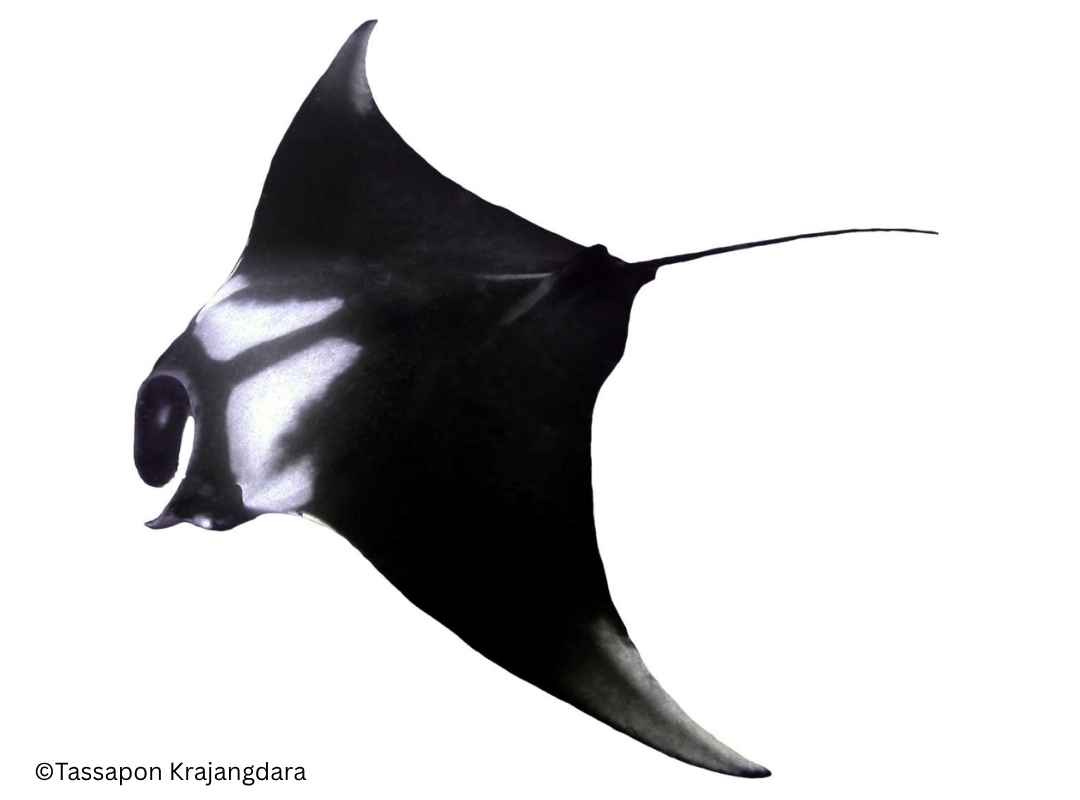
A giant ray having an extremely broad head with long head fins, and a terminal mouth; upper surface of disc covered with denticles, and tail usually without a spine. Blackish above, sometimes with white shoulder patches; white below, with grey edging on disc. Tail whiplike but short.
Biology
Length: The Oceanic Manta Ray may be the largest living ray species, attaining a maximum size of 700 cm disc width (DW) with anecdotal reports up to 910 cm DW. Males mature at 350–400 cm DW and females mature at 380–500 cm DW. Size-at-birth is 122-200 cm.
Gestation period: Unknown
Litter size: upto 2 pups
Life expectancy: Female age-at-maturity is estimated as 8.6 years of age, but first pregnancy may be delayed by up to 4 years (making first age of pregnancy 12 years) depending upon food availability (Rambahiniarison et al. 2018). The maximum age is estimated as 45 years. Generation length is therefore estimated as 29 years.
Diet: Mainly plankton feeders, but may feed on small and moderate-sized fishes as well.
Habitat and distribution
Habitat: The Oceanic Manta Ray is a neritic and oceanic pelagic ray that occurs in places with regular upwelling along coastlines, oceanic islands, and offshore pinnacles and seamounts. The Oceanic Manta Ray can exhibit diel patterns in habitat use, moving inshore during the day to clean and socialize in shallow waters, and then moving offshore at night to feed.
Distribution: The Oceanic Manta Ray is circumglobal in tropical and temperate waters from the surface to 1,000 m depth.
Depth: 0-1000 m
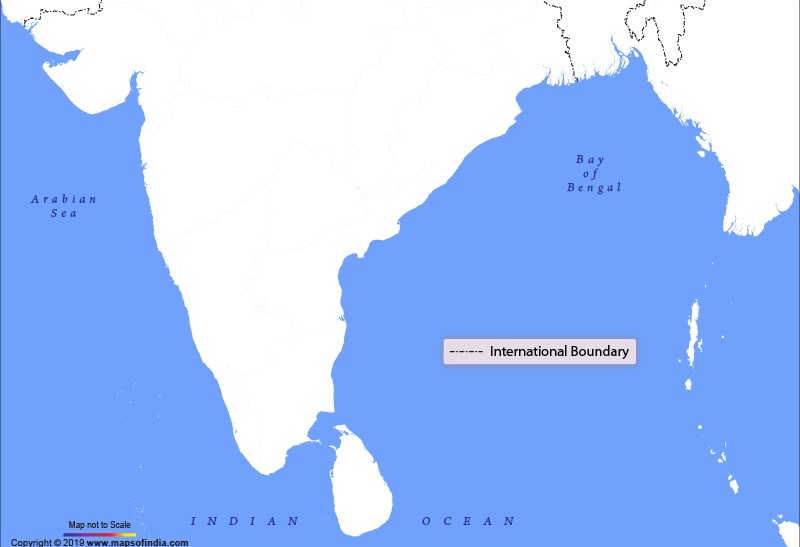
Known landing centres: Royapuram fishing harbour, Cuddalore fishing harbour, Nagapattinam fishing harbour, Cochin fisheries harbour
Commercial value
Mobulids are widely used for their meat, skin, liver oil, and gill plates. The gill plates fetch high prices in Asia and are used for Chinese health tonics. The meat from mobulids is often used for food and shark bait or attractant, and the skin of mobulids is sometimes used for leather products (shoes, wallets, and knife handles). Oceanic Manta Rays are sometimes caught and transported to aquariums for use in display tanks. Some of these captive animals have been released into the wild.
Threats
Mobulid rays, including the Oceanic Manta Ray, are both targeted and caught incidentally in industrial and artisanal fisheries. These rays are captured in a wide range of gear types including harpoons, drift nets, purse seine nets, gill nets, traps, trawls, and longlines. Manta rays are also caught in bather protection nets. Their coastal and offshore distribution, and tendency to aggregate, makes mobulid rays particularly susceptible to bycatch in purse seine and longline fisheries and targeted capture in artisanal fisheries. In particular, Oceanic Manta Rays are easy to target because of their large size, slow swimming speed, tendency to aggregate, predictable habitat use, and lack of human avoidance.
References
Barnes, R.H. (2005)
Indigenous use and management of Whales and other Marine Resources in East Flores and Lembata, Indonesia. 国立民族学博物館 Indigenous Use and Management of Marine Resources.
Burgess, K. (2017)
Feeding ecology and habitat use of the giant manta ray Manta birostris at a key aggregation site off mainland Ecuador. PhD Thesis. University of Queensland.
Cliff, G., Dudley, S.F.J. (2011)
Reducing the environmental impact of shark-control programs: a case study from KwaZulu-Natal, South Africa. Marine and Freshwater Research 62: 700-709.
Compagno, L.J.V. (1999)
Systematics and body form. Pp 1-42. In: W.C. Hamlett (ed.), Sharks, Skates, and Rays: the Biology of Elasmobranch Fishes. John Hopkins University Press, Baltimore.
Compagno, L.J.V. (1997)
Mobulidae. Devil rays. In K.E. Carpenter and V. Niem (eds.) FAO Identification Guide for Fishery Purposes. The Western Central Pacific.
Couturier, L.I.E., Marshall, A.D., Jaine, F.R.A., Kashiwagi, T., Pierce, S.J., Townsend, K.A., Weeks, S.J., Bennet, M.B. and Richardson, A.J. (2012)
Biology, ecology and conservation of the Mobulidae. Journal of Fish Biology 80: 1075-1119.
Croll, D.A., Dewar, H., Dulvy, N.K., Fernando, D., Francis, M.P., Galván-Magaña, F., Hall, M., Heinrichs, S., Marshall, A., McCauley, D., Newton, K.M., Notarbartolo-Di-Sciara, G., O'Malley, M., O'Sullivan, J., Poortlivet, M., Roman, M., Stevens, G., Tershy, B.R. and White, W.T. (2016)
Vulnerabilities and fisheries impacts: the uncertain future of manta and devil rays. Aquatic Conservation: Marine and Freshwater Ecosystems 26(3): 562-575.
Dewar, H. (2002)
Preliminary report: Manta harvest in Lamakera. Report from the Pfleger Institute of Environmental Research and the Nature Conservancy.
Duffy, L. and Griffiths, S. (2017)
Resolving potential redundancy of productivity attributes to improve ecological risk assessments. SAC-08-07c. Inter-American Tropical Tuna Commission. Scientific Advisory Committee Eight Meeting, La Jolla, California (USA), 8-12 May 2017.
Hinojosa-Alvarez S., Walter R.P., Diaz-Jaimes P., Galván-Magaña F. and Paig-Tran E.M. (2016)
A potential third Manta Ray species near the Yucatán Peninsula? Evidence for a recently diverged and novel genetic Manta group from the Gulf of Mexico. PeerJ 4: e2586.
Last, P., White, W., de Carvalho, M., Séret, B., Stehmann, M. and Naylor, G. (2016)
Rays of the World. CSIRO Publishing, Clayton.
O'Malley, M.P., Townsend, K.A., Hilton, P., Heinrichs, S. and Stewart, J.D. (2017) Characterization of the trade in manta and devil ray gill plates in China and South-east Asia through trader surveys. Aquatic Conservation: Marine and Freshwater Ecosystems 27(2): 394-413.
Marshall, A.D. and Bennett, M.B. (2010)
The frequency and effect of shark-inflicted bite injuries to the reef manta ray (Manta alfredi). African Journal of Marine Science 32: 573-580.
Stewart, J.D., Beale, C.S., Fernando, D., Sianipar, A.B., Burton, R.S., Semmens, B.X. and Aburto-Oropeza, O. (2016)
Spatial ecology and conservation of Manta birostris in the Indo-Pacific. Biological Conservation 200: 178–183.