

Species Name
Grey Reef Shark
Scientific Name
Carcharhinus amblyrhynchos (bleeker, 1856)
Family Name
Carcharhinidae
IUCN Status
Endangered
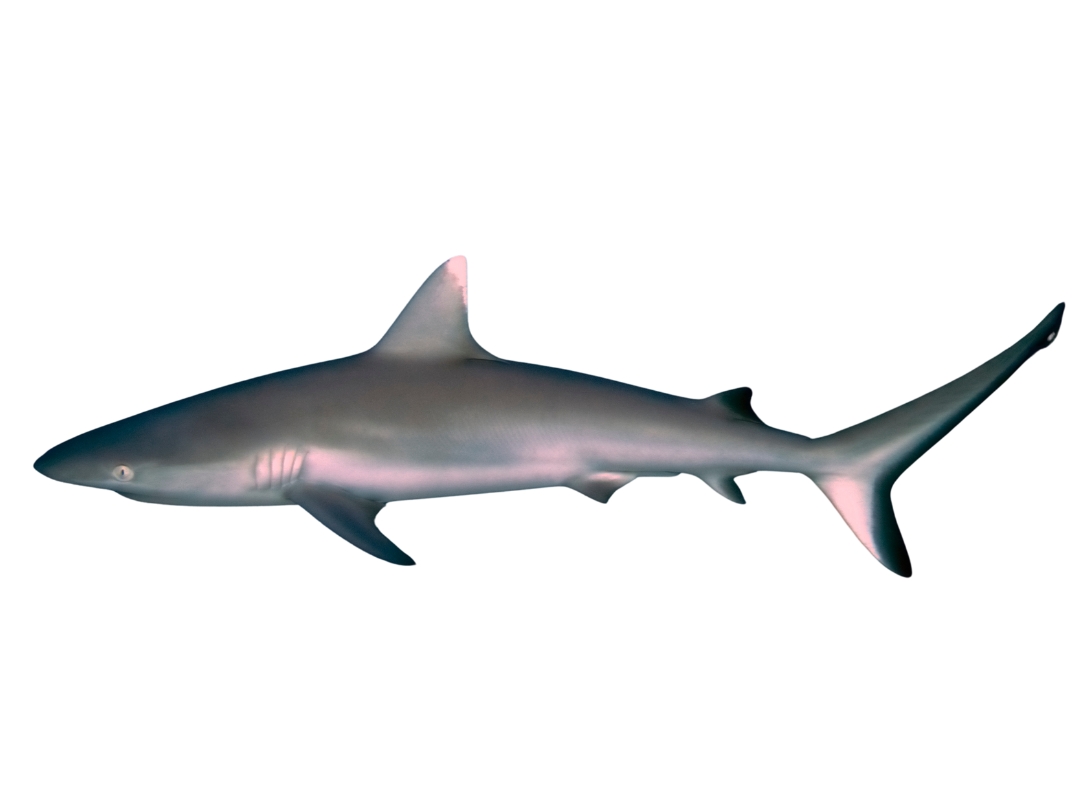
Dark grey or bronze-grey above, white below; caudal fin with a conspicuous wide black posterior margin; undersides of pectoral and pelvic fins with black tips and posterior margins, but fins otherwise not conspicuously black or white-tipped except for white-tipped first dorsal in some individuals.
Biology
Length: Length at maturity 128 cm TL, ranges from 96-142 cm TL. Maximum reported length is 255 cm TL (male) and 172 cm TL (female). Size at birth is around 50-60 cm.
Gestation period: about 12 months
Litter size: 1-6 pups
Life expectancy: 14.5 years (generation) maximum reported length is 25 years.
Diet: Feeds on reef fishes, squids, octopi, crabs, lobsters and shrimps. Tends to be aggressive under baited conditions and readily enters into a frenzy feeding pattern, at which time it may become quite dangerous. Repeatedly incriminated in human attacks.
Habitat and distribution
Habitat: Occurs on continental and insular shelves and oceanic waters adjacent to them. Common on coral reefs, often in deeper areas near drop-offs to the open sea, in atoll passes, and in shallow lagoons adjacent to areas of strong currents. Coastal-pelagic near the bottom, near drop-offs at 1-275 m. Forms daytime schools or aggregations in favored areas.
Distribution: The Grey Reef Shark is widespread in the tropical Indo-West and Central Pacific Oceans, and also occur in some parts of the Eastern Tropical Pacific Ocean.
Depth: 0-280 m
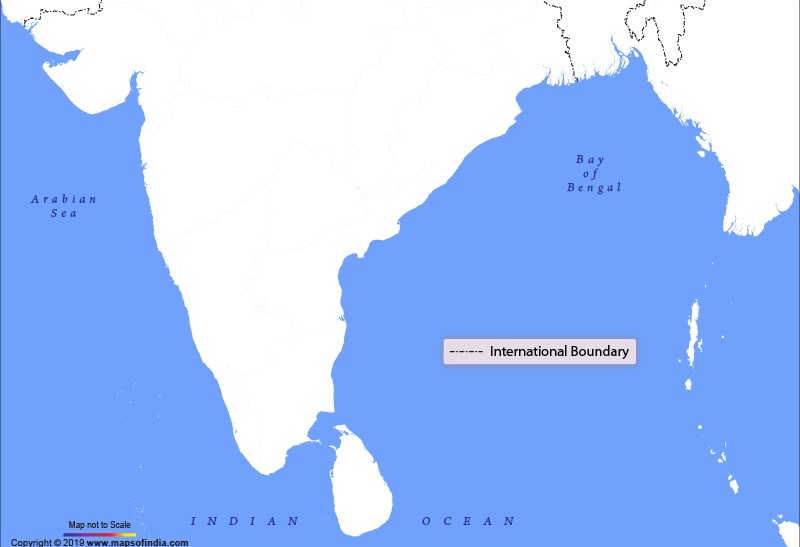
Known landing centres: Sassoon Docks, Royapuram fishing harbour, Cuddalore fishing harbour, Nagapattinam fishing harbour, Thoothukudi, Threshpuram, Tharuvaikulam, Vembar, Vellapatti, Junglighat, Burmanallah, Wandoor, Dignabad, Cochin fisheries harbour.
Commercial value
This is species is retained for its meat, fins, liver and skin Fields et. al. (2018) reported that this species made up 0.31% of fin trimmings sold in Hong Kong. This species is a common display species in public and private aquaria. It is exported live from countries such as Australia and Indonesia to aquaria worldwide. Skins, teeth, and liver are also used in some parts of its range.
Threats
The Grey Reef Shark is caught throughout its range in industrial and small-scale longline, gillnet, trawl and handline fisheries that occur in the waters around coral reefs. There is little species specific information on catches. Most is taken as incidental catch in general reef fisheries targeting teleost fishes. However, it is occasionally taken in industrial scale fisheries.
References
Compagno, L.J.V. and V.H. Niem (1998)
Carcharhinidae. Requiem sharks. p. 1312-1360. In K.E. Carpenter and V.H. Niem (eds.) FAO Identification Guide for Fishery Purposes. The Living Marine Resources of the Western Central Pacific. FAO, Rome.
Compagno, L.J.V., (1984)
FAO Species Catalogue. Vol. 4. Sharks of the world. An annotated and illustrated catalogue of shark species known to date. Part 2 - Carcharhiniformes. FAO Fish. Synop.
Last, P.R. and J.D. Stevens (1994)
Sharks and rays of Australia. CSIRO, Australia. 513 p.
Related Species
- Tiger Shark
- Silky Shark
- Blacktip Reef Shark
- Common Blacktip Shark
- Spot-tail Shark
- Milk Shark
- Spadenose Shark
- Bignose Shark
- Blackspot Shark
- Blue Shark
- Broadfin Shark
- Bull Shark
- Dusky Shark
- Ganges Shark
- Graceful Shark
- Grey Sharpnose Shark
- Hardnose Shark
- Sliteye Shark
- Silvertip Shark
- Sharptooth Lemon Shark
- Sandbar Shark
- Pondicherry Shark
- Pigeye Shark
- Oceanic Whitetip Shark
- Irrawaddy River Shark
- Speartooth Shark
- Spinner Shark
- Whitecheek Shark
- Whitetip Reef Shark